Petrus Solus Auctoritatem Habet

Petrus Solus Auctoritatem Habet” is Latin for Peter alone has Authority.


The Delivery of the Keys, or Christ Giving the Keys to Saint Peter is a fresco by the Italian Renaissance painter Pietro Perugino which was produced in 1481–1482 and is located in the Sistine ChapelRome.

Many Protestants argue that Matthew 16:17-18 the rock is not Peter himself but the confession of Peter.

He said to them, “But who do you say that I am?” Simon Peter replied, “You are the Christ, the Son of the living God.” And Jesus answered him, “Blessed are you, Simon Bar-Jona! For flesh and blood has not revealed this to you, but my Father who is in heaven. And I tell you, you are Peter, and on this rock I will build my church, and the powers of death shall not prevail against it.

Catholic Biblical Association (Great Britain). (1994). The Holy Bible: Revised Standard Version, Catholic edition (Mt 16:15–18). National Council of Churches of Christ in the USA.

None of their exigencies matters because it is focused on the wrong passage. It doesn’t matter if you think the confession is the rock or Peter is. Because the verse doesn’t need Greek or Aramaic language to interpret it correctly.

The next sentence Jesus speaks to only Peter making it clear that Jesus is installing Peter as Prime Minister of His Kingdom, and that Jesus is taking away the Jewish priests ability to “bind and loosen” and giving it to Petert, which is the authority to interpret scripture and to speak on behalf of God in matter of righteous living.

Later in history and scripture, Jesus gives “binding and loosening” to the other apostles but to “Peter Alone” (Petrus Solus) does Jesus give his authority of the Kingdom of God by giving to Peter the Keys of the Kingdom.

Petrus solus auctoritatem habet

Saint Matthew 16:19
“I will give you the keys of the kingdom of heaven, and whatever you bind on earth shall be bound in heaven, and whatever you loose on earth shall be loosed in heaven.”

Catholic Biblical Association (Great Britain). (1994). The Holy Bible: Revised Standard Version, Catholic edition (Mt 16:19). National Council of Churches of Christ in the USA.
Compassion, are we truly broken inside over others infirmities.

Matthew 14:14 (NIV) When Jesus landed and saw a large crowd, he had compassion on them and healed their sick.

  1. σπλαγχνίζομαι splagchnizomai; from 4698; to be moved in the inward parts, i.e. to feel compassion:—feel compassion(2), felt compassion(7), moved with compassion(2), take pity(1).

I’ve know many minister that desperately want the Gifts of Healing in their ministry. And either have had very few genuine healings along with many other “healings” that were questionable or fake. Yet they preach and act like God is doing healing at all their meeting. And when no healing happen they blame the sick for having no faith to be healed or that their sin is keeping them from being healed.

But I think the lack of genuine miraculous healings may have more to do with the hidden motives of the heart.

Just like I see many ministers claiming to be prophets all while giving out more false prophecy than any true prophecies, and sometimes no true prophecies at all.

I see a connection between these two types of ministries.

People are so desperate to hear the true voice of God or receive a healing touch from God for their terminal illness, that people will fill churches and stadiums, spend their last dime, just to listen to false prophets and fake healing ministries, in hopes that they were true messengers of God.

It seems to me many ministers unknowingly want healing and prophesy to be activate in their ministry because of the promotions that it brings for their platform ministries. And so they want bigger platforms, which means bigger donations, which means they can now be in “full time” ministry.

There is a unfortunate understanding in many american church circles, that if you are in full time ministry then you have arrived in your spiritual life. Being able to be fully funded come with many honors from fellow Christians and benefits.

I wonder where are the ministers that have lived among the sick and dying and have their “insides” broken over the pain and suffering that resides in individuals and their families that are crying out to God for mercies of healing.

Where are the ministers today that would move to a leper colony, knowing that once there they can never come back to society, just so they could bring the sick and dying the gospel message and Jesus fully present in body, blood, and Divinity in the eucharist?

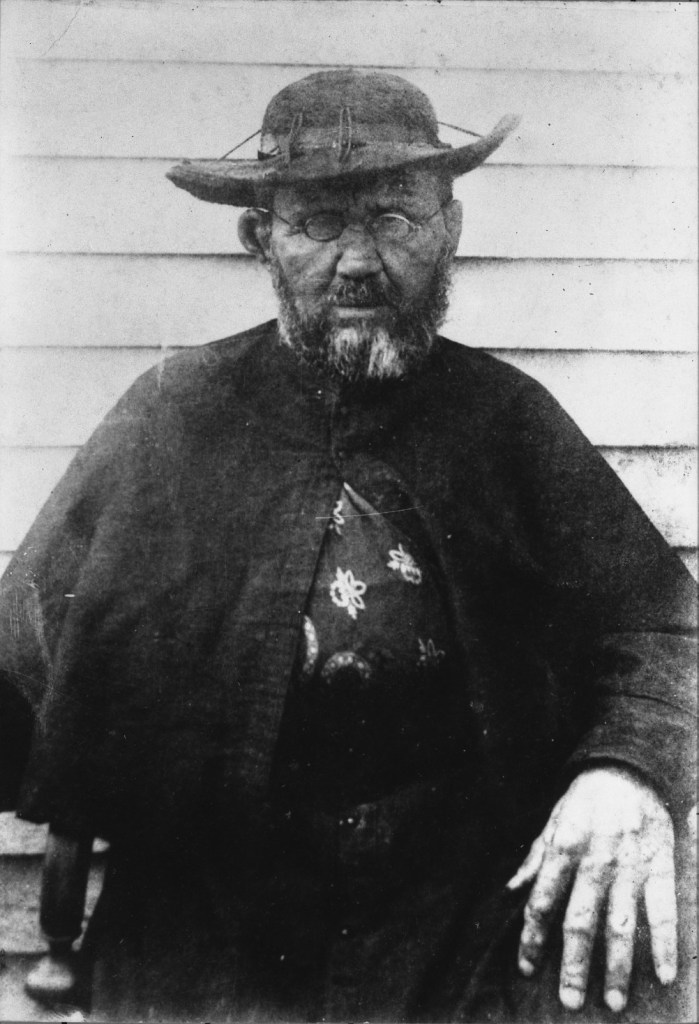
You can learn about Father Damien or know as Saint Damien of Molokai, or Saint Damien De Veuster born 3 January 1840 and died 15 April 1889 from leprosy he contracted from his caring for the sick in the leper colony Molokai, Hawaii.

I wonder would there be more gifts of healings if there was more compassion that come from deep brokenness over other’s suffering from sickness than from the hidden desire for larger platforms, greater number of people attending ministry meetings, and larger donations?

Saint Damien of Molokai taken in 1889, either late February or March, weeks before his death by William Brigham at a side wall of the St. Philomena Catholic Church.

A response to: Fors Clavigera – An Open letter to Praise Bands


Fors Clavigera.

I read James K.A. Smith’s blog post and he brings up three points, mostly centering around a congregation’s ability to sing. But I think the heart of what he is saying is, that if the focus is on the band, then it not about Jesus.

His first point is about volume-there is a place where volume can become so loud that focus the worshipper’s thoughts are on the uncomfortable volume.

His second point is that if we are not all singing the same song, then it’s not worship. I agree and disagree. I think James is trying to make the point that if the band is displaying talent and skill level that is beyond the common person, then the congregation is distracted. It’s less about Jesus as the center of focus and more about the band or musicians.

On this point I’d like to add that when singers are more concerned about changing the key of the song so they can sound their best, and thus putting the song out of most people’s ability to sing, or in a key that is more difficult to play for the musician, then it is more about performance than it about being a servant to the congregation and facilitating worship.

The third point is interesting to me. Almost every church that has “Modern Worship” has the musicians on a stage in front, facing the congragation. This is not the same as in the days of Israel, when the musicians went before the army singing and playing the praise of God. The Israelis didn’t face the army. As a matter of fact, they were between the army and the enemy, facing the enemy, similar to David being between the army of Israel and Goliath. But when I went to my grandmother’s Catholic Church as a young child, the musician’s were in the balcony, out of sight, and the congregation faced the Altar which they believe held the real body and blood Jesus. They believed that Jesus was present on the alter and even bowed when they walked passed the Altar because Jesus was present.

Now the bread and wine are not even present in the service we call worship and the congregation faces the band. What are we really worshiping by our actions?